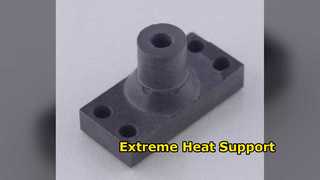
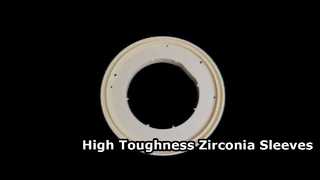
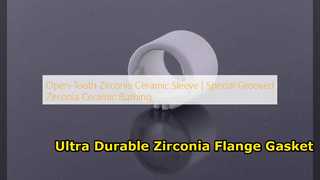
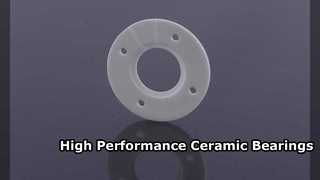
Brief: Let’s dive in — see this solution in action and notice the key moments. This video provides a detailed walkthrough of the specially grooved silicon carbide ceramic flange, demonstrating its precision positioning and connection capabilities in high-temperature environments. You'll see how its unique design and material properties ensure high rigidity and reliability in demanding applications like semiconductor equipment and high-temperature mechanical systems.
Related Product Features:
Manufactured from reaction bonded silicon carbide for exceptional mechanical properties and thermal stability.
Features a precision-machined special-shaped central groove and five evenly distributed through-holes for accurate positioning.
Offers super high rigidity and hardness, ensuring minimal deformation and high positional accuracy.
Capable of long-term operation at temperatures up to 1550°C without softening or deforming.
Excellent thermal shock resistance withstands rapid temperature changes without cracking.
Outstanding chemical stability resists acidic, alkaline environments, and molten metals.
Low coefficient of thermal expansion ensures stable fits and connections across a broad temperature range.
Ideal for precision equipment positioning, mechanical connection, and transmission systems in extreme environments.
FAQs:
What is the main difference between a Silicon Carbide flange and a Zirconia flange?
The main differences lie in thermal conductivity and temperature resistance. Silicon Carbide has excellent thermal conductivity and a maximum use temperature of 1550°C, which is much higher than Zirconia's approximately 1100°C. However, Zirconia generally has higher fracture toughness at room temperature.
Can the central special-shaped groove be made into other non-standard shapes?
Yes. With strong CNC machining capabilities, we can customize various complex special-shaped grooves according to your drawings, such as D-shapes, squares, polygons, or specific spline grooves.
Will this flange disc gall or seize with connecting bolts at high temperatures?
If directly connected with common metal bolts, there is a risk of diffusion bonding at extremely high temperatures. We strongly recommend using high-temperature alloy bolts combined with specialized anti-galling coatings or ceramic washers for high-temperature applications.